The simplest, most effective poker strategy for a beginner is what we call “tight and aggressive.” It’s a two-part philosophy: be very selective about the hands you choose to play (that’s the “tight” part), and when you do play them, bet and raise with confidence (that’s the “aggressive” part).
This approach builds big pots when you have the best of it and gets your opponents to fold when they have weaker hands. Nail this down, and you’re already on the path to becoming a profitable player.
Building Your Foundation for Winning Poker
So, you’ve decided to take poker seriously. Welcome. The felt can be an intimidating place, but a winning strategy isn't built on complicated bluffs or wild guesses. It’s built on a few solid pillars.
Moving beyond just knowing the hand rankings is your first big step. This guide is all about building your game from the ground up, focusing on the simple, effective principles that actually work.
The Modern Poker Mindset
Poker isn't the same game it was 20 years ago. Back then, it was all about gut feelings and staring down your opponents. Today, the best players lean heavily on math and solid, data-driven decisions.
It's a crucial shift to understand. Modern winning poker is built on making smart, calculated plays, not just winging it. Think about it: only about 5% of all poker players are long-term winners. That tells you discipline and a sharp, analytical approach are what separate the pros from everyone else.
What You Will Learn
Our journey starts with the most important decision you'll make in any hand: which cards to play before the flop even comes out. From there, we'll get into why your seat at the table is so incredibly important.
Here's what we'll cover:
- Selective Aggression: Learning which hands are worth your money and how to bet them with purpose.
- Positional Power: How to use your seat to gain an information edge and control the hand.
- Fundamental Tactics: The simple math behind betting for value and knowing when it's time to let a hand go.
The real goal here is to make profitable decisions over and over again. By focusing on these core ideas, you’ll build a solid framework that helps you avoid the classic mistakes most new players make.
Of course, before you can strategize, you need to have the rules down cold. If you need a quick refresher, our guide on the will get you up to speed. Make sure you’re comfortable with the basics before diving in here.
Mastering Pre-Flop Hand Selection
Every single poker hand starts with the same simple but crucial decision: should I play these two cards, or should I fold? Those first two cards are the foundation you'll build your entire hand on, and if you start with shoddy materials, your whole strategy is likely to crumble.
I've seen it a thousand times: the biggest mistake beginners make is playing way too many hands. It's easy to get sucked in by the hope of hitting a miracle flop, but that's a fast track to a dwindling chip stack. Smart, disciplined poker is about folding the junk and waiting for the right moment to pounce with a strong hand. This discipline saves you from getting trapped in tough spots after the flop, where a weak starting hand often snowballs into much costlier errors.
Tiering Your Starting Hands
It helps to think about starting hands in a few simple categories. They aren't all created equal, and knowing where your hand stands from the get-go is key.
The Monsters: We’re talking about the absolute best of the best. Hands like AA, KK, QQ, and AK are the cream of the crop. You should almost always come out raising with these to build a bigger pot right from the start.
The Strong Contenders: This next group includes solid pairs like JJ, TT, and 99 , along with high-card combos like AQ, AJ, and KQ. These are definitely moneymakers, but they require a bit more finesse and caution than the monster hands.
The Speculative Plays: This is where you find hands with potential, like suited connectors (8♠7♠) or small pocket pairs (66, 55). These hands are long shots to win on their own, but they have the sneaky ability to turn into powerful straights, flushes, or sets. The best time to play these is from late position, especially if you can get in cheap.
Your entire game plan for a hand is dictated by this initial decision. This visual really drives home that your starting cards are all you have to go on at first.
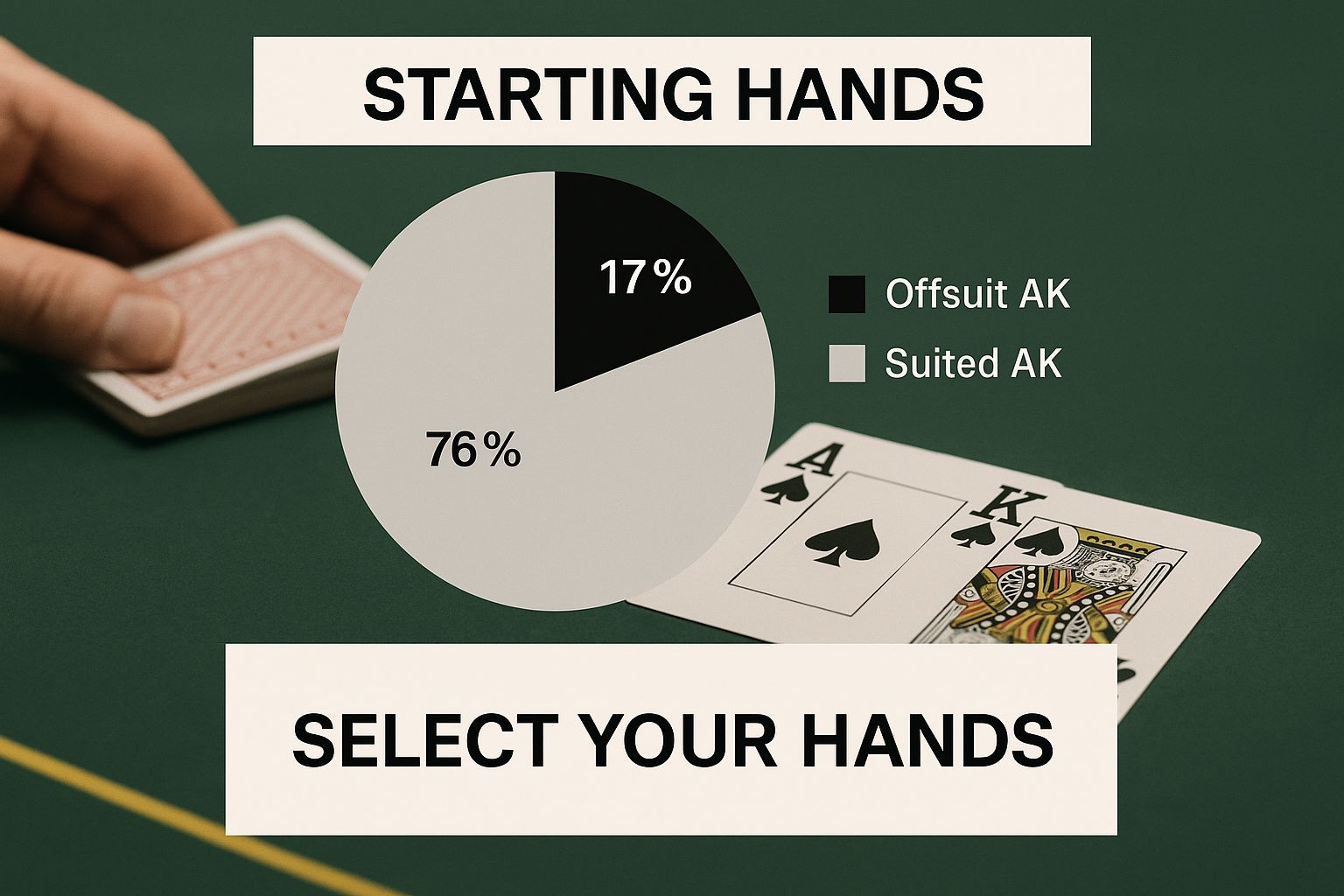
As the image suggests, the quality of what you start with is everything. It sets the stage for every bet, call, or fold that follows.
To make this even clearer, here’s a simplified table to help you categorize hands at a glance.
Beginner's Pre-Flop Hand Tiers
This table offers a simplified guide to starting hand strength. As a beginner, you should be playing hands in Tier 1 & 2 most of the time, getting very selective with Tier 3 , and folding almost everything in Tier 4.
| Hand Tier | Example Hands | General Strategy |
|---|---|---|
| Tier 1 | AA, KK, QQ, AKs, AKo | Raise aggressively from any position. Your goal is to build a big pot. |
| Tier 2 | JJ, TT, AQs, AQo, AJs | Strong hands worth raising, but be cautious if you face a lot of re-raising action. |
| Tier 3 | 99-77, KQs, ATo, suited connectors (98s) | Playable, but position is key. Best played from late position or when the pot is un-raised. |
| Tier 4 | Any two unsuited low cards (94o, 72o) | Fold. These hands are easily dominated and will cost you money in the long run. |
Sticking to this kind of hierarchy will keep you out of a lot of trouble as you're learning the ropes.
The Simple Logic Behind Folding Trash
Now, let's talk about the biggest category of all: pure junk. I'm talking about hands like an offsuit 9-4, a Jack-2, or a King-3. The main issue with these hands isn't just that they're weak—it's that they are easily dominated.
Let me give you a classic example. Say you decide to play King-3, and the flop comes down King-high. You've hit top pair! Feels great, right? Well, probably not. If anyone else at the table is holding King-Jack or Ace-King, you are "outkicked." You both have a pair of kings, but their second card (the "kicker") is higher than yours. This is a perfect recipe for losing a very big pot.
The discipline to muck your junk hands pre-flop is what truly separates break-even players from consistent winners. You're not just sitting there waiting for pocket aces; you're waiting for a genuinely profitable situation to invest your chips.
Learning which hands to play from which position is a cornerstone skill. For a deeper dive into hand selection and other foundational concepts, check out our Texas Hold'em guide. Getting this part of your pre-flop poker strategy right is the first major step toward becoming a successful player.
Why Your Seat at the Poker Table is Everything

If picking good starting hands is the what of solid poker, your position at the table is the how. It's not just about the cards you're dealt; it’s about when you have to act on them.
Acting last is the single biggest tactical advantage you can have in any given hand. Seriously. You get a front-row seat to see what everyone else does before a single chip has to leave your stack. Did they check, hinting at weakness? Or did they bet out, showing strength? This free information is absolute gold and a concept that separates winning players from the rest.
Early, Middle, and Late Position: Know Where You Stand
Every seat at the table belongs to one of three zones. Figuring out which one you're in is the first step to making better decisions.
Early Position (EP): This is rough territory. You're one of the first to act, which means you're flying blind. This includes the Small and Big Blinds, plus the seat to the left of the Big Blind, famously called "Under the Gun" (UTG). From here, you need to play extremely tight with only your strongest hands.
Middle Position (MP): Things loosen up a little here. You've seen the EP players act, but there are still several dangerous opponents behind you. You can start to play a few more hands, but you still need to be very selective.
Late Position (LP): Now we're talking. This is the Cutoff (CO) and the most powerful seat in poker, the Button (BTN). These are the money seats. You have the most information, which allows you to play a much wider variety of hands and control the action.
When you hear a pro talk about being "in position ," they mean they get to act after their opponent on every street (flop, turn, and river). The Button is king because it guarantees you'll be in position for the rest of the hand if you see a flop.
Position in Action: A Tale of Two Hands
Let's make this real. Say you look down and see Jack-Ten suited. It's a pretty-looking hand with potential, but its value completely changes based on where you're sitting.
Imagine you're Under the Gun, the first one to act. Playing J-T suited here is asking for trouble. You have zero clue what the eight players behind you are holding. One of them could easily be sitting on pocket Aces, just waiting to re-raise you. You’re playing in the dark, and the smart, disciplined play is almost always to fold.
Now, let’s fast-forward. The action folds all the way around to you on the Button. Suddenly, that same Jack-Ten suited transforms into a monster. It’s an automatic raise. Your goal is to steal the blinds right there, and even if you get called, you hold the ultimate trump card: position. You get to see what your opponent does for the rest of the hand before you make a move.
The core principle is simple: the later your position, the wider the range of hands you can profitably play. You should be trying to play most of your hands from the Cutoff and the Button. Get this down, and you'll see your results improve faster than almost any other skill you can learn.
Learning Essential Betting Tactics
https://www.youtube.com/embed/yWiiQQ59r4w
At the poker table, your chips aren't just for keeping score—they're your weapons. How you bet, when you bet, and how much you bet tells a story, puts your opponents on the spot, and is ultimately what wins you the pot. Simply calling and seeing what happens isn't a strategy; it's a recipe for going broke. The key is to understand why you're putting chips in the middle.
Every single bet you make should have a purpose. Are you betting for value, hoping a worse hand will call you? Or are you bluffing, trying to get a better hand to fold? Having that clarity is the first step.
The Continuation Bet: A Beginner's Best Friend
One of the first, and most effective, tactical bets you should master is the continuation bet (often called a c-bet). The concept is simple: you were the aggressor who raised before the flop, so you continue that aggression by betting again on the flop, whether you hit it or not.
Why is this so powerful? Think about it. Most of the time, the flop doesn't help anyone. By betting, you’re continuing the story you started pre-flop—that you have a big hand. This simple, aggressive play will often take the pot down right then and there.
Calculating Your Odds on the Fly
Poker isn't all about raw aggression, though. It's also a game of calculated risk. When you're facing a bet and holding a drawing hand (like four cards to a flush or a straight), you have to know if calling is actually worth the price. Guessing is expensive. Basic math is your best friend.
A really simple shortcut for this is the ‘Rule of 2 and 4’. To figure out your chances of hitting your hand, you just need to count your "outs"—the cards left in the deck that will complete your draw.
- After the flop, multiply your outs by 4 to get a rough percentage of hitting by the river.
- On the turn, multiply your outs by 2 to see your chances of hitting on the river.
Let's walk through a common scenario.
- Your Hand: You're holding two hearts.
- The Flop: Two more hearts hit the board, giving you a flush draw.
- Calculating Outs: There are 13 hearts in a deck. You can see four of them (two in your hand, two on the board), which means there are 9 hearts left in the deck. These are your outs.
Using our rule, we multiply 9 outs by 4 , which gives you roughly a 36% chance of making your flush by the time the last card is dealt. This percentage is your baseline for deciding if a call is profitable by comparing it to the pot odds (the ratio of the pot size to the size of the bet you must call).
Knowing your odds turns a hopeful gamble into a calculated investment. If the pot offers you a better price than your odds of hitting, calling is a profitable play over the long haul. For a deeper dive, our Poker Odds guide breaks down these concepts in detail.
This fundamental math is the foundation for almost every decision you'll make. It might seem basic, but getting it right will stop you from bleeding chips on bad calls and help you spot situations where you should be putting more money in. It also gives you a better sense of when a bluff might be your best option. If you want to dive deeper into the art of deception, check out our guide on how to bluff in poker.
Managing Your Bankroll for Long-Term Success
You could be the most talented player at the table, but if you go broke, none of that skill matters. This is where bankroll management comes in. It’s the single most important, and often most overlooked, skill that separates players who have long careers from those who burn out in a flash.
Think of your poker money as your business's operating budget, not just a gambling stake. The entire point is to play in games where you can easily absorb a nasty losing streak without it crippling you or forcing you to play scared. This all starts with understanding the "buy-in."
For most no-limit cash games, a standard buy-in is 100 big blinds. So, if you're playing a $0.05/$0.10 game (often called 10NL), a single buy-in is $10. Simple as that.
The 20-30 Buy-In Rule
When you're just starting out, being cautious with your money is the only way to go. A rock-solid rule of thumb is to have at least 20 to 30 buy-ins for whatever stakes you’re playing.
Let’s put that into real numbers:
- For a $0.05/$0.10 (10NL) game: You’ll want a bankroll of $200-$300.
- For a $0.01/$0.02 (2NL) game: Your bankroll should be $40-$60.
This cushion does more than just keep you from going bust. It gives you mental freedom. When you know a bad beat or a losing session won't wipe you out, you can focus on making the right plays, not the "safe" ones. For a deeper dive, check out our bankroll management guide.
Having a proper bankroll means you can absorb the shocks of variance—the inevitable lucky and unlucky swings in poker—and stay in the game long enough for your skill edge to pay off.
Discipline is the name of the game, especially at the micro stakes. Don't get discouraged if progress feels slow. A solid win rate for a beginner at the lowest stakes (like 2NL) might only be around 4 big blinds per 100 hands , and that number gets smaller as the competition gets tougher at higher levels.
Moving Up and Down in Stakes
Your poker journey isn't a straight line up. Knowing when to climb the ladder—and when to step back down—is crucial for survival.
Moving Up: So you've been crushing it. Once you've built your bankroll to 30 buy-ins for the next level up , it's time to consider taking a shot. For example, you grind your 10NL bankroll from $300 up to $750. That's 30 buy-ins for 25NL ($0.10/$0.25), so you can feel confident trying out the higher-stakes game.
Moving Down: Here's the hard part. Let's say your shot at the new level doesn't go well and your bankroll dips back down to 20 buy-ins for that level. You must have the discipline to drop back to your old stakes. This isn't admitting defeat; it's smart, professional management that ensures you live to fight another day.
Common Poker Questions for Beginners
As you start your poker journey, you're going to have a ton of questions. That’s perfectly normal. Getting the right answers to these early sticking points is one of the biggest shortcuts to building a solid, winning strategy.
Let's walk through some of the most common questions I hear from new players. Getting a handle on these fundamentals will save you a lot of frustration—and money—at the tables.
What Is the Biggest Mistake Beginners Make?
Without a doubt, it’s playing too many hands. When you're just starting, it's easy to get impatient or feel like you’re missing out if you’re not in every pot. This is a classic beginner trap.
Jumping into the action with weak starting hands like an unsuited King-five or Jack-seven is a one-way ticket to trouble. You'll constantly find yourself in tricky, money-losing spots after the flop, often dominated by a better kicker or facing bets you just can't call. The cornerstone of a good poker strategy is discipline.
Learning to fold junk hands before the flop is just as important as knowing how to play your monsters. Sticking to a tight range of premium starting hands, especially when you're in early position, will instantly plug the biggest leak in your game.
How Do I Know When to Bluff?
Think of bluffing as a precision tool, not a sledgehammer. For beginners, the best approach is to bluff rarely and only in the most opportune spots. A good bluff has to tell a story that makes sense.
So, when are the best times to pull the trigger on a bluff?
- When you're in late position: This is a huge advantage because you get to see what everyone else does first. If an opponent shows weakness by checking to you, it can be a green light to bet.
- Against one or two opponents: Trying to bluff a whole table is just asking to get called. The more players in a hand, the higher the chance someone actually connected with the board.
- On a "scary" board: Let's say you raised before the flop and an Ace or King hits the board. A follow-up bet (a continuation bet) often takes down the pot right there, because your bet tells the story that you have that high card.
And here’s a pro tip: avoid bluffing "calling stations"—those players who seem to call any bet with any piece of the board. Your bluffs are far more powerful when they’re aimed at thoughtful players who can actually be pushed off a hand. You can dig deeper into this and other key concepts by exploring our poker strategy hub.
How Much Money Do I Need to Start Playing?
This all comes down to good bankroll management. The golden rule is simple but non-negotiable: never play with money you can't afford to lose.
The actual amount you need depends entirely on the stakes you plan to play. If you're starting with online micro-stakes cash games, like $0.01/$0.02 No-Limit Hold'em (what players call 2NL) , a good starting bankroll is between $50 and $60. This gives you 25-30 full buy-ins, since a standard buy-in is 100 big blinds ($2 at 2NL).
For low-stakes tournaments with a $5 buy-in, you’ll want a bankroll of at least $250 (which is 50 buy-ins). Having a proper bankroll is your armor against variance—the natural ups and downs of poker. It frees you up to play your best game without fear, letting you focus on making the right long-term decisions instead of sweating every single result.
Related Reading:
Once you've mastered these beginner fundamentals, explore our Poker Strategy Hub to continue advancing your skills and understanding of the game.
At PokerSites.org , we're here to help players at every level sharpen their skills and find the best online tables. Dive into our huge library of guides and reviews to keep building your poker foundation. Find your perfect poker room today by visiting us at </>.
Article created using(https://outrank.so)